
The 2024 Kedron Brook Flood Study (Brisbane City Council, Vol. 1) deserves more attention from the flood hydrology profession than it has received. It contains one of the more transparent flood frequency analyses I’ve seen published for an Australian urban catchment — Bayes_GP fitting with 90% confidence limits, sensitivity analysis excluding the 2022 events, and proper annotation of historical events on the frequency curve.
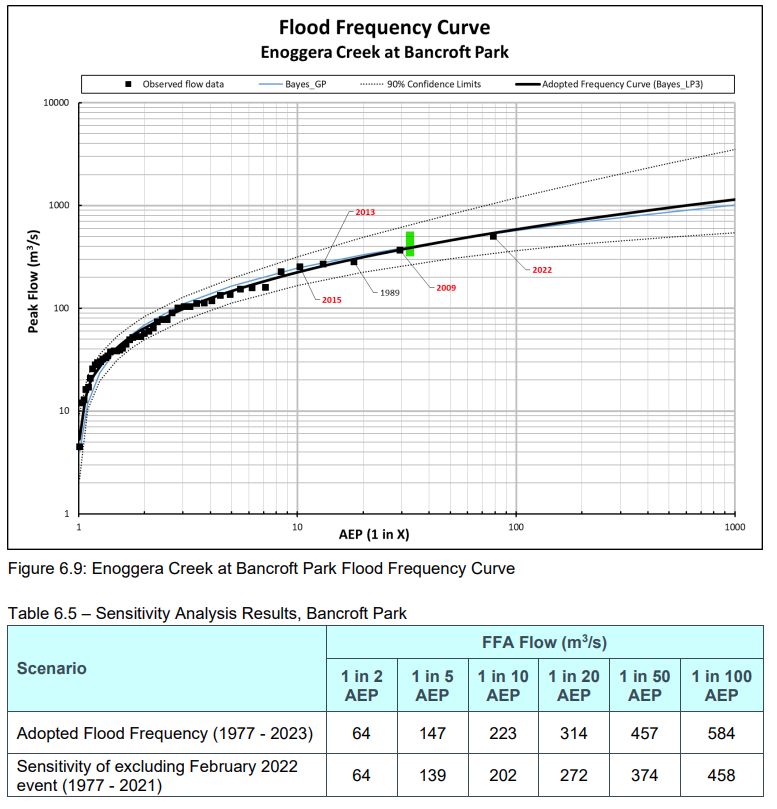
The key chart is Figure 6.9 — the flood frequency curve for Enoggera Creek at Bancroft Park.
What the Data Actually Says
Based on Figure 4.3 and Table 6.5, reading the 2022 event flows at two key gauges:
McCord St Alert (near Thistle St, Kedron Brook):
- Peak: approximately 11.1 mAHD → ~310 m³/s
- AEP classification: approximately 10% AEP (1-in-10 year event)
Bancroft Park (Kelvin Grove Alert / Park Run gauge):
- Peak: approximately 6.5 mAHD → ~340 m³/s
- AEP classification: similar magnitude to the 2009 event, approximately 5% AEP (1-in-20 year event) when 2022 is included in the FFA
Under ARR 2019 terminology, these flows sit in the rare band (1–5% AEP). They are not classified as very rare (0.2–1% AEP) and certainly not as extreme (<0.1% AEP).
The “Unprecedented” Problem
This matters because of how the 2022 Brisbane flood events were described publicly and — more problematically — in some technical reports.
“Unprecedented” carries a specific technical meaning in flood hydrology: it implies the event exceeds the historical record in a way that prevents frequency characterisation. That’s not what the FFA shows for these gauges. A 5–10% AEP event is a rare event, not an unprecedented one. It should occur, on average, roughly every 10–20 years.
The practical consequence of misclassifying rare events as unprecedented is that it distorts flood risk communication, creates unrealistic community expectations about recurrence, and can lead to infrastructure decisions calibrated to the wrong design standard.
The Sensitivity Analysis Question
The study includes a sensitivity analysis comparing the Adopted FFA against a run excluding the 2022 data. This is good practice — the 2022 event is a large outlier relative to the pre-2022 record at some gauges, and testing whether its inclusion substantially shifts the frequency curve is important for understanding parametric uncertainty.
The results of that sensitivity analysis are shown in Table 6.5. Where the two FFA estimates diverge significantly at the rare end of the distribution (5% AEP and below), it flags that the record is being heavily influenced by a small number of large events — which increases uncertainty in design flood estimates for major infrastructure.
The Broader Lesson
This is exactly the kind of analysis the profession should be doing systematically in the wake of major flood events: proper Bayesian flood frequency analysis with confidence limits, clear AEP classification using ARR 2019 terminology, and sensitivity testing around influential data points.
What it shows is that the 2022 Brisbane floods — devastating as they were in terms of human and economic impact — were not statistically unprecedented at most gauge locations. They were large, rare events on a historical trajectory that Australia’s eastern seaboard should expect to repeat.
Planning for the next 5–10% AEP event, rather than treating 2022 as a one-in-a-lifetime anomaly, is the appropriate engineering response.
Source: Kedron Brook Flood Study 2024, Vol. 1 — Brisbane City Council (For Information Only — Not Council Policy). Flood frequency curve Figure 6.9 and Table 6.5 reproduced for educational commentary. Originally shared on LinkedIn — 88 reactions · 4 comments.