
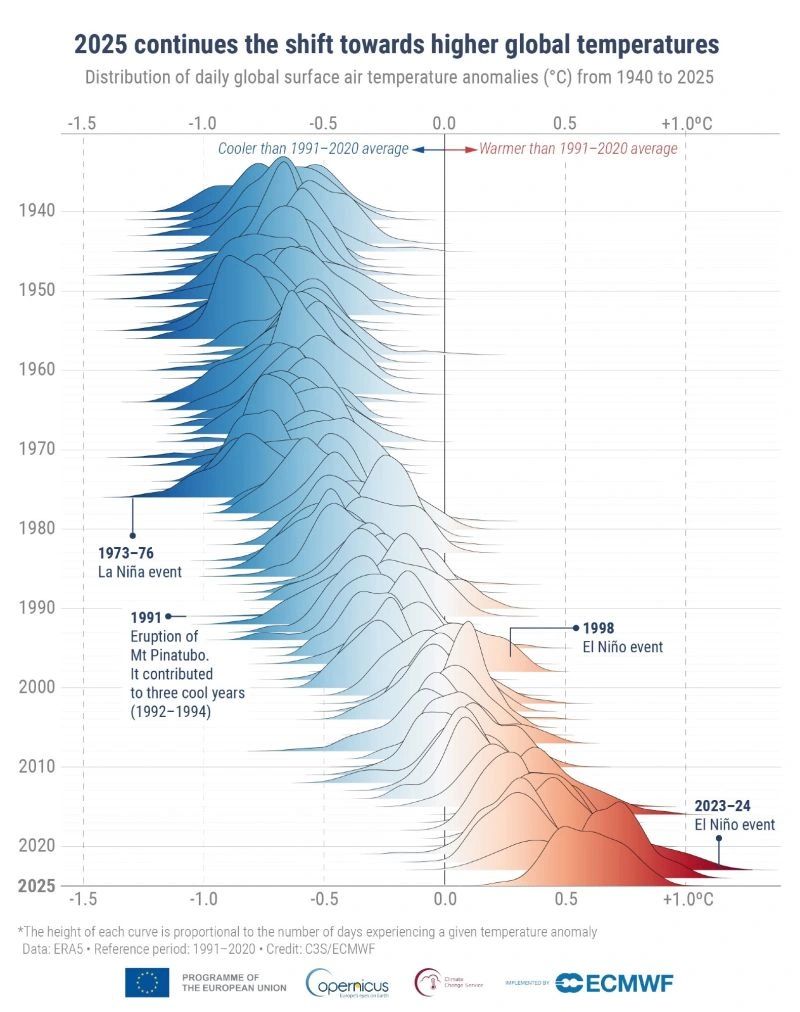
The global temperature record has been rewritten three times in three years. According to independent analyses by NASA, NOAA, WMO, and Berkeley Earth:
- 2024: approximately 1.54°C above pre-industrial levels — the hottest year on record
- 2023: 1.48–1.60°C — second hottest
- 2025: 1.44°C — third hottest, and notably a La Niña year
That last point is significant. La Niña conditions typically produce cooler global temperatures. Climate scientists have pointed to years like 2025 — still ranking third-hottest despite La Niña forcing — as evidence that the background warming signal is now overwhelming the natural variability that previously made La Niña years reliably cooler.
The Evaporation Problem Nobody Is Calculating
The engineering and planning conversation about climate change and water security focuses heavily on precipitation — reduced inflows, shifted seasonality, more intense but shorter wet periods. These are real. But they’re visible.
The mechanism that worries me more is the one that operates silently between rain events: open water evaporation from reservoirs.
The physics is straightforward. Pan evaporation rates scale with temperature, vapour pressure deficit, and wind. As ambient temperatures increase, open water evaporation from reservoir surfaces accelerates. For large, shallow storage basins, the effect is material.
For a storage system like Wivenhoe Dam (Lake Wivenhoe surface area ~109 km² at full supply level), a 10% increase in annual evaporation rate represents tens of gigalitres of additional water loss annually — water that doesn’t appear in the rainfall-runoff model, doesn’t show up in inflow statistics, and doesn’t get credited in demand projections.
One estimate puts the atmosphere pulling approximately 40% of annual storage capacity from major Australian reservoirs through evaporation — a fraction some researchers expect to keep increasing as temperatures rise.
Why This Doesn’t Appear in Water Security Assessments
Most water security assessments for Australian urban water supplies are built around a historical sequence approach: run the system model (demand vs inflows) through the 1890–present historical record and identify critical drought sequences. The Millennium Drought period (roughly 2001–2009) typically emerges as the critical design sequence for SEQ.
The problem is that the evaporation losses embedded in historical inflow records reflect the climate of those periods — cooler, on average, than the present and near-future climate. When we run the historical sequence model forward as a planning tool, we’re implicitly assuming historical evaporation rates continue.
If evaporation rates have structurally increased — and the evidence suggests they have — then the “historical worst case” isn’t the worst case anymore. The effective yield of the storage system is lower than the model says, even when running the same historical inflow sequence.
The Implications for Storage Operations
This has three concrete implications for dam operators and water planners:
1. Trigger levels need recalibration. If the model says “at 40% storage we have X months of supply,” but evaporative losses are 15% higher than the model assumes, the actual supply horizon is shorter. Operational trigger levels may need to be raised to preserve the same margin.
2. Drought response planning underestimates severity. Water restriction levels and demand management triggers are calibrated against historical drought trajectories. If the underlying loss function has changed, those triggers may activate later than they should.
3. The next Millennium Drought could be worse. Not just because inflows may be lower, but because the losses between rain events would likely be higher too. A storage entering a multi-year drought at equivalent percentage levels would face higher absolute evaporation losses in a warmer climate.
What Honest Planning Looks Like
Accounting for this requires moving away from simple historical sequence replay toward climate-adjusted modelling — applying temperature-driven evaporation adjustments to the historical inflow record, or using climate model projections to develop synthetic sequences that embed future evaporation rates.
This is technically achievable. The AWRA-L model framework already produces evapotranspiration estimates at daily time steps. Applying CMIP6 temperature projections to drive future evaporation rates for storage modelling is a tractable problem.
The barrier isn’t technical. It’s institutional. Water security reporting frameworks, trigger level methodologies, and demand planning guidelines are built around the historical sequence approach. Updating them requires acknowledging that the baseline has changed — which has regulatory and political dimensions that go beyond the hydrology.
But the physics doesn’t care about institutional convenience. The silent drawdown continues.
Originally shared on LinkedIn — 37 reactions · 5 comments.